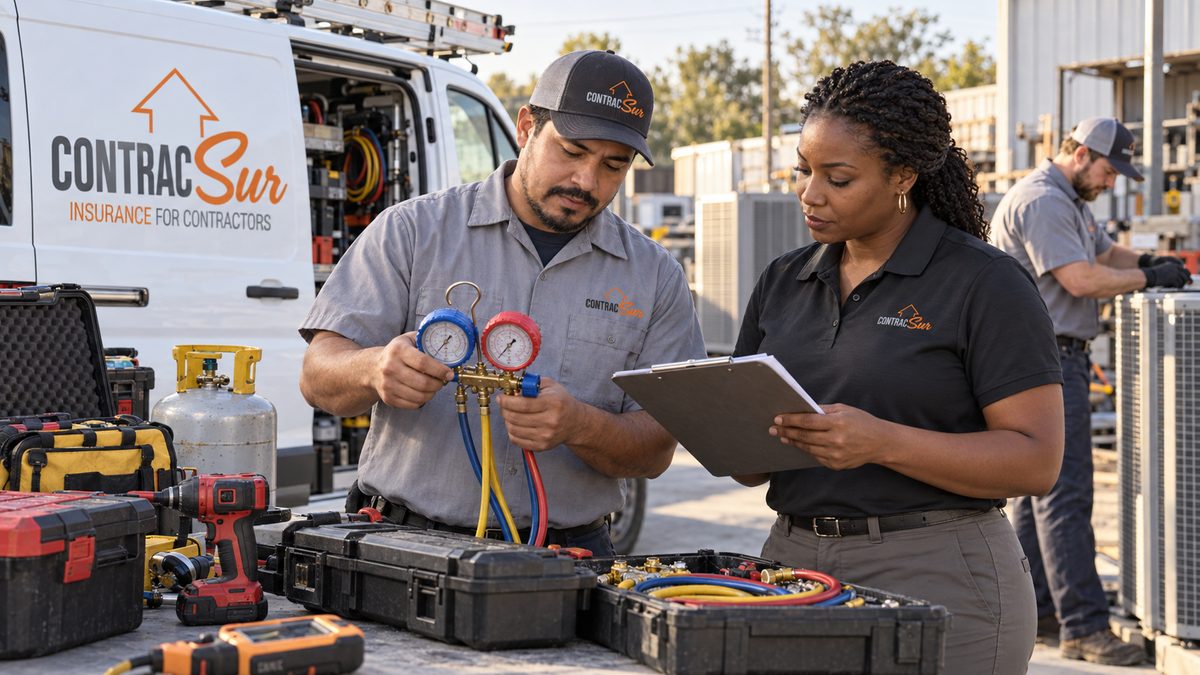

As the year winds down, your HVAC business may look different from when its insurance policies were issued. You may have added service vehicles, hired technicians, increased payroll, purchased equipment or signed contracts with new insurance requirements.
A year-end review helps identify operational changes that should be discussed with your insurance agent before renewals, audits or new projects begin. Use this checklist to review your Business Auto, Workers’ Compensation, General Liability, tools and equipment coverage, and certificate requirements.
Review Your Business Auto Information
Service vehicles are central to an HVAC operation. They carry technicians, tools and equipment between customer homes, commercial properties and the shop.
Review your fleet and confirm that the policy accurately reflects:
- Each business-owned or insured vehicle
- Vehicle ownership and garaging locations
- How each vehicle is used
- The normal operating area
- Employees authorized to drive
- Liability and physical-damage selections
- Any vehicles sold or taken out of service
Notify your agent when vehicles or regular drivers change. Insurance companies may have different driver-eligibility and underwriting requirements, so adding an employee to the payroll does not necessarily mean that employee has been reviewed as a driver.
Review Tools Carried in Service Vehicles
Business Auto insurance does not automatically insure every tool or piece of equipment carried inside a service vehicle.
Review the value of:
- Hand and power tools
- Diagnostic equipment
- Refrigerant recovery equipment
- Ladders
- Replacement parts
- Materials awaiting installation
These items may require contractors equipment, inland marine or another property coverage form. Confirm where coverage applies, including inside vehicles, in transit, at temporary jobsites and overnight.
Review Workers’ Compensation Information
Adding employees or changing job duties may affect the payroll estimates and classifications used to calculate workers’ compensation premiums.
Review:
- The number of employees
- Actual employee duties
- Field and office classifications
- Estimated annual payroll
- Overtime and other included remuneration
- Employees who also drive company vehicles
- Subcontractor documentation
Texas does not require most private employers to carry workers’ compensation, although customer contracts, general contractors and government projects may require it. Employers operating without coverage also have state notice and reporting responsibilities.
Verify Classifications and Payroll
Employees should be classified according to the work they actually perform. A field technician, salesperson and office employee may present different exposures.
Payroll estimates should also reflect expected operations for the coming policy period. A final audit may compare the original estimates with actual payroll and classifications, which can result in an additional premium or a return premium.
Accurate records help make the audit more predictable, but they do not guarantee a particular premium or claim outcome.
Review General Liability and Contract Requirements
Your operations may have expanded during the year. Discuss changes such as:
- New residential or commercial services
- Work in new territories
- Larger projects
- Increased subcontractor use
- New construction or installation work
- Changes in annual sales or payroll
- Contracts requiring higher limits
- Additional-insured or waiver requirements
General Liability insurance may help respond to certain third-party bodily injury or property damage claims, subject to the policy’s terms, conditions and exclusions. It does not replace Business Auto, Workers’ Compensation or coverage for the contractor’s own tools.
Review Certificates and Endorsements
A Certificate of Insurance provides evidence of existing insurance. It does not create coverage, make someone an additional insured or change the policy.
Before a project begins:
- Send the insurance requirements to your agent
- Confirm the required policy limits
- Identify additional-insured requirements
- Review waiver-of-subrogation requirements
- Confirm whether primary and noncontributory wording is required
- Allow time for any necessary endorsements
- Request the appropriate COI from your agent
Do not wait until the morning work is scheduled to begin. A COI can only reflect the policies and endorsements that are actually in place.
Inventory Tools and Equipment
Compare your current equipment with the schedule, limits and valuation provisions in your policy.
Review:
- Newly purchased tools
- High-value diagnostic equipment
- Equipment kept in service vehicles
- Rented or borrowed equipment
- Property stored at the shop
- Equipment left temporarily at jobsites
- Applicable deductibles
- Replacement-cost or actual-cash-value provisions
- Theft and security requirements
Maintain purchase records, serial numbers and photographs when practical. Good documentation can help identify what was owned and its value if a covered loss occurs.
Year-End HVAC Insurance Checklist
Before the new year:
- Update vehicle and driver information
- Review how service vehicles are owned and used
- Confirm how tools inside vehicles are insured
- Compare estimated payroll with current payroll
- Verify employee duties and workers’ compensation classifications
- Report significant operational changes
- Review General Liability and Umbrella limits
- Inventory tools and equipment
- Send new contract requirements to your agent
- Request current COIs when needed
- Confirm that required endorsements are actually included
Frequently Asked QuestionsDoes Business Auto insurance cover tools inside an HVAC van?
Not necessarily. Business Auto generally addresses covered vehicles and auto-related liability. Tools and equipment may require contractors equipment, inland marine or another property coverage form.
Why should payroll estimates be reviewed?
Workers’ compensation premiums are commonly based partly on payroll and classifications. An audit may compare estimated figures with actual results and adjust the premium accordingly.
Does a COI provide additional-insured coverage?
No. A COI provides evidence of existing insurance. Additional-insured status generally depends on the policy and applicable endorsement.
When should an HVAC contractor contact its insurance agent?
Contact your agent when adding vehicles or drivers, hiring employees, changing services, purchasing significant equipment or signing contracts with new insurance requirements.
Final CTA
Your HVAC business should not enter a new year with insurance information based on last year’s operation.
Learn more about insurance for Texas HVAC contractors or request a quote from ContracSur.
Coverage varies by policy and insurance company. This information is general and is not a substitute for reviewing your policies, endorsements, contracts and operations.